What Is Digital Marketing? A Complete Beginner’s Guide
- Date
- 13-08-2026
- Author
- thisbrand.in2026
- Read
- 11 min
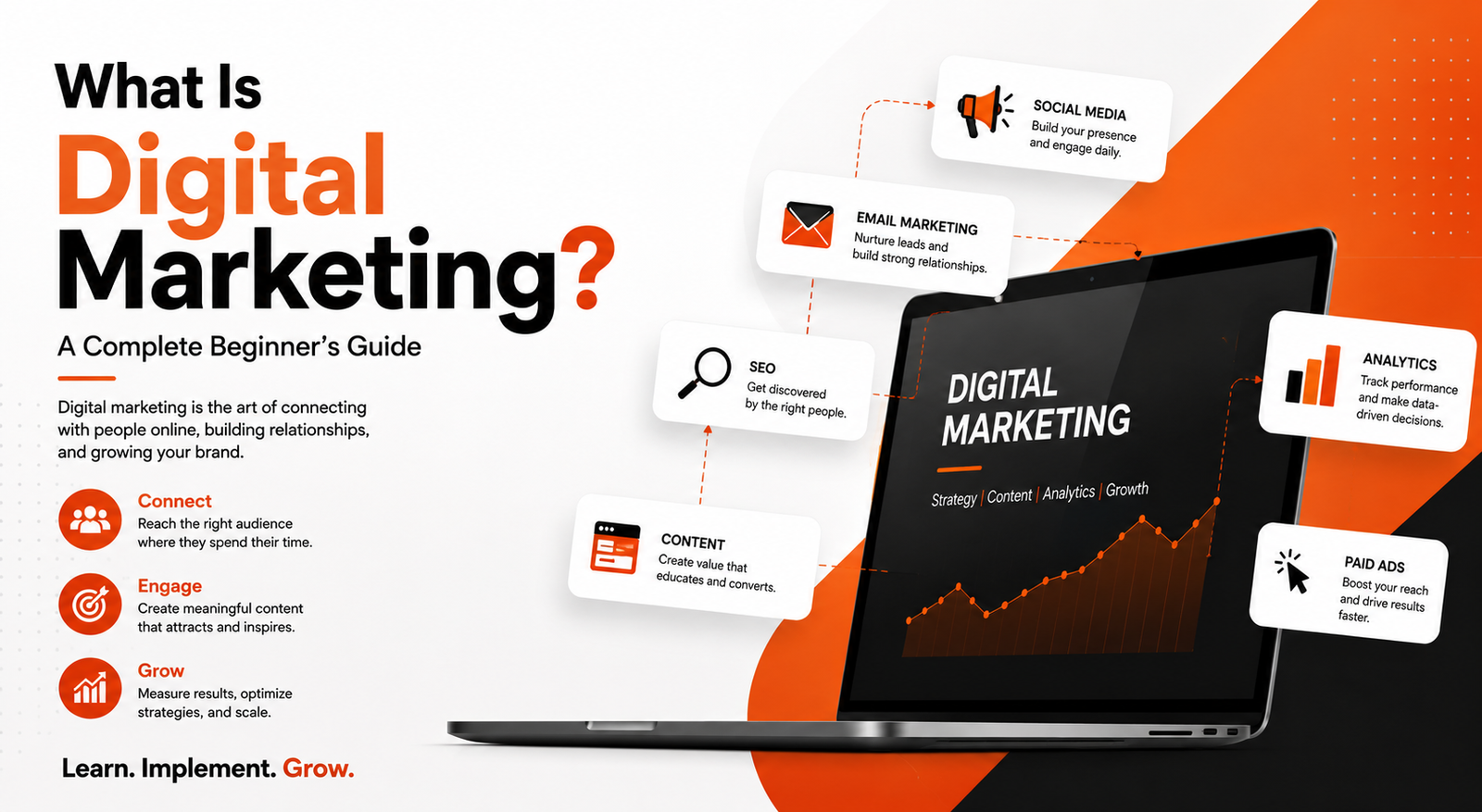
Learn what digital marketing means, how it works, the main channels businesses use, and how beginners can build a simple digital marketing strategy.
Think about the last time you wanted to buy something you had never purchased before.
You probably searched online, checked a few websites, compared prices or features, looked at reviews, and maybe visited the brand’s social media page before making a decision.
That simple process explains why digital marketing has become so important.
Businesses today are not only competing for customers through physical stores or traditional advertisements. They are competing for attention on search engines, social media, websites, email, video platforms, and countless other digital channels.
But what exactly is digital marketing?
In simple terms, digital marketing is the process of promoting a business, product, service, or brand through digital channels such as search engines, websites, social media, email, online advertising, and digital content.
For beginners, however, digital marketing can seem confusing. SEO, PPC, content marketing, social media marketing, email marketing, analytics, and automation are all different areas, but they often work together.
This guide explains the basics without unnecessary jargon, so you can understand what digital marketing actually involves and where to start.
What Is Digital Marketing?
Digital marketing is marketing carried out through digital devices and online channels.
Instead of relying only on newspapers, television, radio, magazines, or billboards, businesses use platforms such as Google, websites, Instagram, LinkedIn, YouTube, email, and online advertising networks to reach potential customers.
The goal isn’t simply to get attention.
Good digital marketing helps a business:
- Reach the right audience
- Build brand awareness
- Attract website visitors
- Generate leads
- Increase sales
- Build customer relationships
- Measure marketing performance
A Simple Example
Imagine someone searches Google for “website development company.”
They find a company’s blog through search, visit the website, look at its services, check previous work, read reviews, and eventually submit a contact form.
That one customer may have interacted with several parts of the company’s digital marketing strategy before becoming a lead.
- SEO helped them find the business.
- The website provided information.
- Content helped answer their questions.
- Branding created a professional impression.
- The contact form made conversion possible.
That is digital marketing working as a system.
How Does Digital Marketing Work?
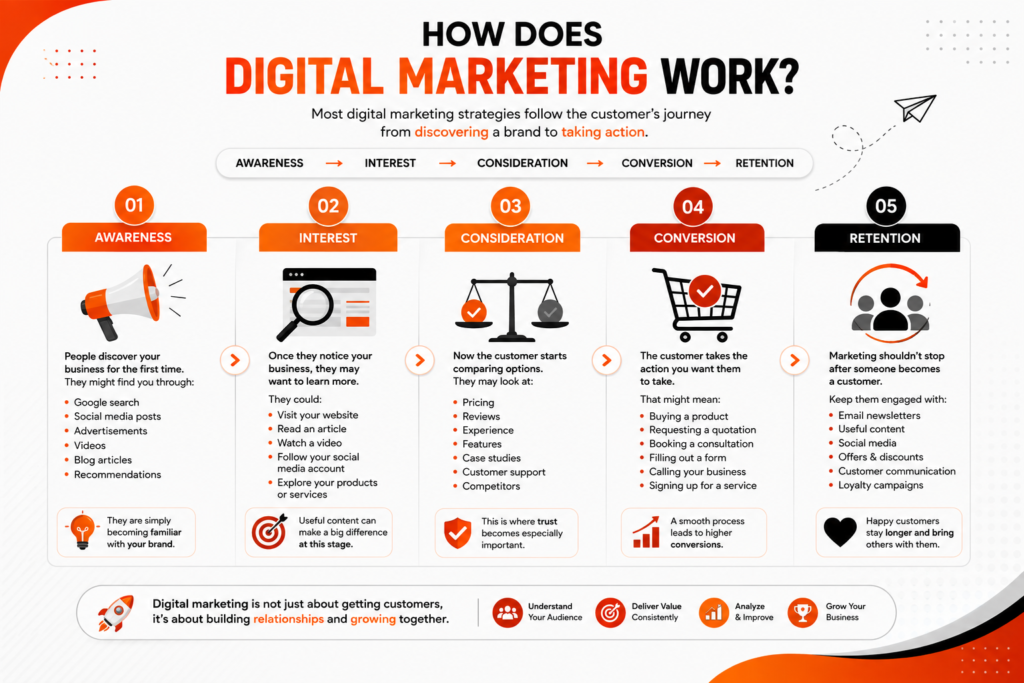
Most digital marketing strategies follow the customer’s journey from discovering a brand to taking action.
A simple version looks like this:
Awareness → Interest → Consideration → Conversion → Retention
01 — Awareness
First, people need to know that your business exists.
They might discover you through:
- A Google search
- Social media posts
- Advertisements
- Videos
- Blog articles
- Recommendations
At this point, they may not be ready to buy anything. They are simply becoming familiar with your brand.02 — Interest
Once they notice your business, they may want to learn more.
They could:
- Visit your website
- Read an article
- Watch a video
- Follow your social media account
- Explore your products or services
Useful content can make a big difference here.
03 — Consideration
Now the customer starts comparing options.
They may look at:
- Pricing
- Reviews
- Experience
- Features
- Case studies
- Customer support
- Competitors
This is where trust becomes especially important.
04 — Conversion
The customer takes the action you want them to take.
That might mean:
- Buying a product
- Requesting a quotation
- Booking a consultation
- Filling out a form
- Calling your business
- Signing up for a service
05 — Retention
Marketing shouldn’t necessarily stop after someone becomes a customer.
Email newsletters, useful content, social media, offers, customer communication, and loyalty campaigns can help businesses maintain long-term relationships.
Why Is Digital Marketing Important?
People increasingly research businesses online before making purchasing decisions.
Even when someone eventually buys something offline, their journey may have started with an online search.
This gives businesses a major opportunity to reach potential customers before competitors do.
Reach the Right Audience
Digital platforms allow businesses to target specific audiences based on factors such as:
- Location
- Interests
- Demographics
- Behavior
- Search intent
For example, a local restaurant doesn’t need to advertise to people across the entire country. It can focus its marketing on people who are actually nearby.
Build Brand Awareness
Customers often need to see a brand several times before they remember or trust it.
A consistent presence across your website, search results, social media, email, and advertising can help build recognition.
Branding matters here too. Consistent visuals, messaging, and tone make a business easier to recognize and can create a more professional impression.
Generate Leads and Sales
Digital marketing can reach people who are already looking for a solution.
Someone searching for “CRM software for small business,” for example, has already expressed a potential need.
A useful article, service page, advertisement, or product demonstration can introduce that person to your business.
Measure What Works
Digital marketing provides businesses with valuable data.
Businesses can monitor:
- Website traffic
- Clicks
- Engagement
- Leads
- Conversion rates
- Advertising costs
- Search performance
- Sales
This makes it easier to identify what is working and where money or effort is being wasted.
Main Types of Digital Marketing
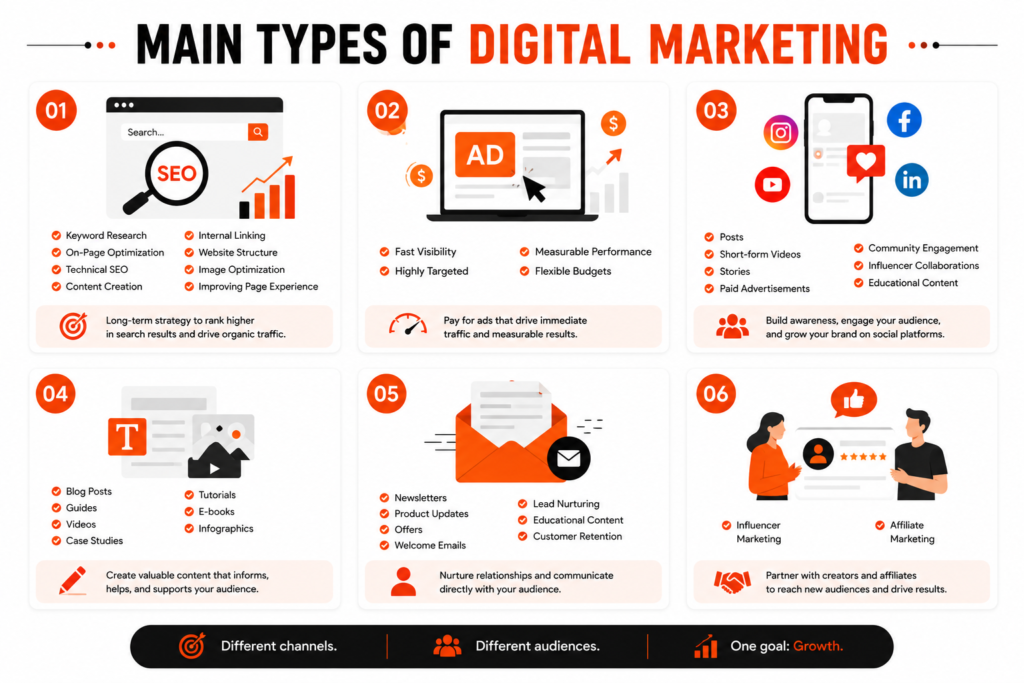
Digital marketing is not one single activity.
It includes several channels, each with a different purpose.
You don’t need to use all of them. The right combination depends on your audience, industry, goals, and budget.
01 — Search Engine Optimization (SEO)
Search Engine Optimization, or SEO, is the process of improving a website so it can appear more prominently in relevant organic search results.
SEO can include:
- Keyword research
- On-page optimization
- Technical SEO
- Content creation
- Internal linking
- Website structure
- Image optimization
- Improving page experience
For example, a digital marketing company might publish an article explaining how SEO works for small businesses.
If that article provides a useful answer to something people are searching for, it can potentially attract organic traffic over time.
SEO is generally a long-term strategy.
It isn’t about repeating the same keyword dozens of times. The real objective is to create useful content and a website that both search engines and visitors can understand.
02 — Pay-Per-Click Advertising (PPC)
PPC advertising allows businesses to pay for advertisements displayed on search engines and other digital platforms.
In many PPC campaigns, advertisers pay when someone clicks an advertisement.
For example, a company selling accounting software could run advertisements for searches related to accounting software.
Advantages of PPC
- Fast visibility
- Highly targeted campaigns
- Measurable performance
- Flexible budgets
One major advantage of PPC is speed. A well-managed campaign can start generating visibility much faster than many organic strategies.
The downside is that advertising costs continue as the campaign runs, so performance needs to be monitored carefully.
03 — Social Media Marketing
Social media marketing involves using social platforms to build awareness, communicate with customers, share content, and promote products or services.
It can include:
- Posts
- Short-form videos
- Stories
- Paid advertisements
- Community engagement
- Influencer collaborations
- Educational content
The important thing to remember is that social media isn’t simply about posting every day.
A B2B company may get better results from LinkedIn, while a visual consumer brand might find Instagram or YouTube more suitable.
The platform should follow the audience — not the other way around.
04 — Content Marketing
Content marketing focuses on creating useful information for a specific audience.
Common formats include:
- Blog posts
- Guides
- Videos
- Case studies
- Tutorials
- E-books
- Infographics
Good content should give people a reason to spend time with your brand.
It might:
- Answer a question
- Explain a complicated subject
- Solve a problem
- Help someone make a purchasing decision
Content can also support other marketing channels.
One detailed blog post can become a social media post, email newsletter, video script, or downloadable guide.
05 — Email Marketing
Email marketing gives businesses a direct way to communicate with people who have chosen to receive their messages.
Businesses use email for:
- Newsletters
- Product updates
- Offers
- Welcome emails
- Lead nurturing
- Educational content
- Customer retention
Unlike social media, where an algorithm determines who sees your content, an email list gives you a more direct communication channel.
The key is relevance.
People are much more likely to stay subscribed when emails are genuinely useful.
06 — Influencer & Affiliate Marketing
Influencer marketing involves working with creators who have an established audience.
Affiliate marketing is usually performance-based, with partners receiving compensation for generating a defined result such as a sale or lead.
Both can help businesses reach audiences they may not easily reach on their own.
Digital Marketing vs. Traditional Marketing
Digital and traditional marketing have the same basic goal: reaching customers and encouraging action.
The main difference is how they do it.
| Factor | Digital Marketing | Traditional Marketing |
| Channels | Search, websites, social media, email, online ads | TV, radio, print, billboards |
| Targeting | Highly flexible | Generally broader |
| Measurement | Detailed digital data | Often harder to measure precisely |
| Interaction | Immediate and interactive | Usually limited |
| Flexibility | Campaigns can be changed quickly | Changes can require new production |
| Reach | Local to global | Depends on the medium |
This doesn’t mean traditional marketing is useless.
Television, radio, print, and outdoor advertising can still work very well in the right situation.
Digital marketing simply gives businesses additional ways to reach and understand their customers.
How to Create a Digital Marketing Strategy
you don’t need a complicated marketing plan to get started.A beginner can follow these practical steps.
01 — Define Your Goal
Start with one clear objective.
You might want to:
- Increase website traffic
- Generate more leads
- Increase sales
- Build brand awareness
- Improve customer retention
Trying to achieve everything at once makes it harder to know whether your strategy is working.
02 — Understand Your Audience
Find out who your customers are and what they actually need.
Ask yourself:
- What problem are they trying to solve?
- What questions do they ask?
- Where do they search for information?
- What influences their decisions?
- Which platforms do they use?
The better you understand your audience, the easier it becomes to create relevant marketing.
03 — Build a Strong Website
Your website is often the foundation of your online presence.
It should be:
- Mobile-friendly
- Fast
- Easy to navigate
- Clear about your services
- Visually professional
- Easy to contact
There’s little value in spending money to bring people to a website that is difficult to use.
04 — Choose the Right Channels
Don’t try to be everywhere.
If customers search Google for your services, SEO and PPC may be useful.
If your products are highly visual, social media and video may be more effective.
If you already have a strong database of customers or leads, email marketing can be valuable.
Choose channels according to customer behavior and business goals — not simply because everyone else is using them.
05 — Create Useful Content
Instead of constantly asking:
“What should we post today?”
Ask:
“What does our customer need help with?”
That simple change can improve your content strategy.
Create articles, videos, guides, and other resources that genuinely help your audience.
06 — Measure the Results
Track the metrics that matter.
A simple marketing journey can look like:
Visitors → Leads → Customers → Revenue
Likes and followers can be useful indicators, but they shouldn’t become the main definition of marketing success.
07 — Improve Over Time
Your first campaign won’t always be perfect.
Study the data, test different approaches, keep what works, and improve what doesn’t.
Digital marketing is an ongoing process, not a one-time task.
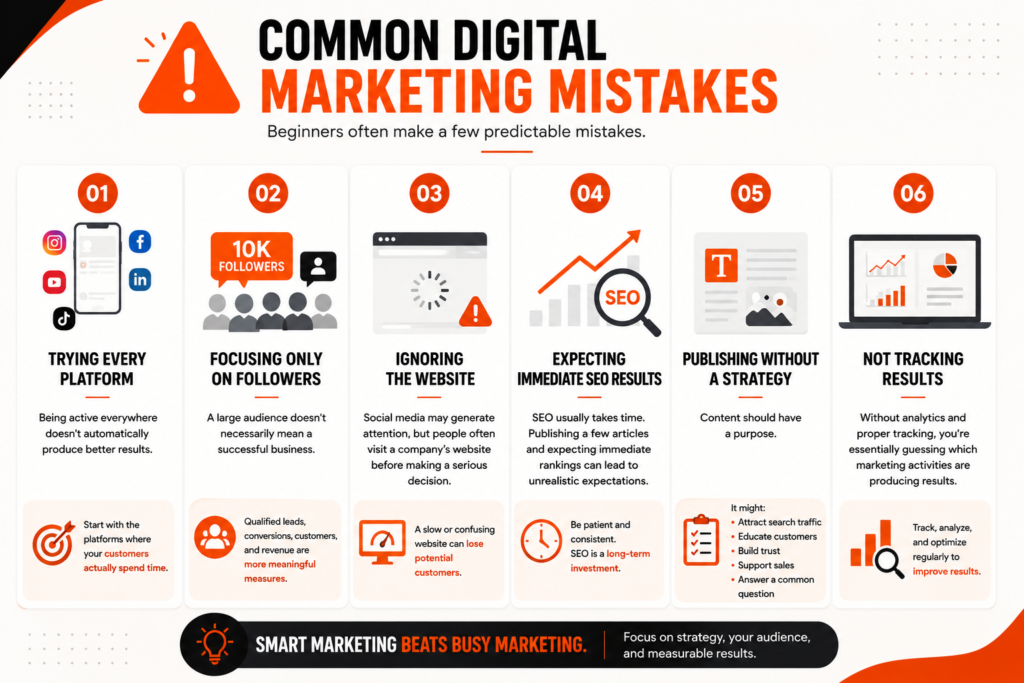
Common Digital Marketing Mistakes
Beginners often make a few predictable mistakes.
Trying Every Platform
Being active everywhere doesn’t automatically produce better results.
Start with the platforms where your customers actually spend time.
Focusing Only on Followers
A large audience doesn’t necessarily mean a successful business.
Qualified leads, conversions, customers, and revenue are usually more meaningful measures.
Ignoring the Website
Social media may generate attention, but people often visit a company’s website before making a serious decision.
A slow or confusing website can lose potential customers.
Expecting Immediate SEO Results
SEO usually takes time.
Publishing a few articles and expecting immediate rankings can lead to unrealistic expectations.
Publishing Without a Strategy
Content should have a purpose.
It might:
- Attract search traffic
- Educate customers
- Build trust
- Support sales
- Answer a common question
Not Tracking Results
Without analytics and proper tracking, you’re essentially guessing which marketing activities are producing results.
Conclusion
Digital marketing is much more than social media posts and online advertisements.
It is a complete way of connecting businesses with customers through the digital channels they already use.
For beginners, the most important thing is not to learn every platform at once.
Start with the basics:
Understand your audience.
Define your goal.
Build a strong online presence.
Choose the right channels.
Create useful content.
Measure the results.
Improve continuously.
You don’t need a massive budget or a complicated strategy to begin.
What matters is understanding where your customers are, what they need, and how your business can provide a useful answer.
Digital platforms will continue to change. New technologies, AI tools, search experiences, and social platforms will reshape the way businesses market themselves.
But the fundamental idea will remain simple:
Reach the right people, provide something genuinely useful, earn their trust, and make it easy for them to take the next step.
That is the foundation of effective digital marketing.